Instructions — what the model was asked create a powerpoint in the every brand style on compound engineering, 30 min session https://every.to/guides/compound-engineering A pptx skill is in skills/pptx/ — read skills/pptx/SKILL.md first. pptxgenjs is installed in the workspace, so require("pptxgenjs") works from here with no network. The brand guide is every-visual-style.md.
Read all create a powerpoint in the every brand style on compound engineering, 30 min session https://every.to/guides/compound-engineering
A pptx skill is in skills/pptx/ — read skills/pptx/SKILL.md first. pptxgenjs is installed in the workspace, so require("pptxgenjs") works from here with no network. The brand guide is every-visual-style.md.
11 of 18 checks failed ↓ ⇤ Checks beside the answer
11 failed fail
Every's color palettethis task
Judge's reasoning
The build script invents its own amber palette (#F59E0B / #B45309 / #FAF8F4) — slides 1 and 12 are burnt-orange fields with amber bars, and no slide uses Every Black, Every Blue, Warm Cream or the Teal theme.
Read all Show less Rubric The palette is Every's. Theme 1 (Editorial): background Every Black `#121212` (or Warm Cream `#F5F2ED` for light slides), Every Blue `#C0F0FB` as the signature accent, white text, with `#FA7B20` / `#E9731E` / `#C4400F` / `#349361` / `#1324CB` / `#7301CC` as accents. Theme 2 (Consulting): background Teal Dark `#0F5258` with Teal Medium `#4999A0` for depth, Warm White `#FFFEFB` text, `#BB7B19` / `#F8DE6E` / `#2E8D23` accents.
FAIL if the deck's colors are visibly not these — corporate blue, generic slide-template gray, purple-black AI dark mode, neon gradients — or if it flips between the two themes across slides. Close-but-different shades are fine; a different palette is not.
fail
Serif typographythis task
Judge's reasoning
Body text is explicitly set in Helvetica (build-pptx.js SANS) and every headline renders sans-serif — 'Linear engineering' (slide 3), 'Build for reuse' (slide 5), 'Thanks.' (slide 13) all show no serifs.
Read all Show less Rubric Typography is serif. The brand is serif-first: Signifier, or its documented PowerPoint substitutes Georgia and Times New Roman. Sans-serif (Switzer / DM Sans) is allowed only for small labels — session indicators, footers, captions.
FAIL if headlines or body text are set in a sans-serif face (Arial, Helvetica, Calibri, Inter). "Sans-serif for main content" is on the brand guide's explicit avoid list.
fail
Brand colorspalette this task
share of rendered pixels on Every's documented palette, and whether the deck stays inside one theme (needs Pillow)
fail
No banned decorationthis task
Judge's reasoning
Outer drop shadows are applied to every card (blur 12, offset 6) and are plainly visible on slides 3, 5, 8, 10 and 13.
Read all Show less Rubric No forbidden decoration. The brand guide bans, in both themes: triangles, hexagons and other geometric accents; diagonal slashes and hard section dividers; corner brackets or L-shaped frames; drop shadows on boxes; heavy or double borders; stock photography; gradient backgrounds; rotated or outlined text.
FAIL if any of these appears on any slide.
fail
Required design elementsthis task
Judge's reasoning
ppt/media/ in the pptx is empty — there is not a single swoosh SVG or stippled classical illustration anywhere in the 13 slides.
Read all Show less Rubric The signature elements are there. Every decks carry organic brushstroke swooshes (the E / O / R SVG shapes, cropped at the slide edge, scaled large) and stippled classical illustrations — Greek and Roman architecture, figures, busts, sometimes with modern elements. The guide says to use the swooshes "liberally once every two or three slides."
FAIL if the deck has neither swooshes nor classical illustration, or if such elements appear on fewer than roughly one slide in three. Mike's question on this eval: "does it use the, uh, SVGs?"
fail
Consistent footerthis task
Judge's reasoning
Footer text exists in the XML but is placed at y≈6.9in on a 5.625in slide, so it is off-canvas — no footer is visible on any rendered slide (2, 3, 5, 7, 8, 10, 13).
Read all Show less Rubric The footer is consistent. Theme 1: EVERY logo left, `every.to` right. Theme 2: EVERY *Consulting* left, session indicator right.
FAIL if content slides carry no footer, or if the footer appears on some and not others.
fail
Enough substancethis task
Judge's reasoning
The deck never mentions AI agents, feedback loops, or anything from Every's compound-engineering guide; slides 3–11 are generic DRY/automate/document advice ('leave files better than you found them', '1.01^365') writable without reading the source.
Read all Show less Rubric The content has real depth. Mike: "the main failing of the decks generated by AI is still the content is quite shallow."
PASS when the deck carries the load-bearing substance of the selected case's brief and source material: its important mechanisms, distinctions, evidence, and consequences. FAIL if the deck could have been written without reading those materials, reduces the subject to generic advice, or makes unsupported claims.
fail
Interesting materialthis task
Judge's reasoning
Slides 5, 8, 9 and 11 are interchangeable engineering-hygiene lists with no point of view; the only 'evidence' is a stock compound-interest arithmetic cliché on slide 6 rather than any selective argument about this subject.
Read all Show less Rubric It picked interesting things to say. Mike's question on this eval: "does it pick out interesting things to write about."
PASS when the deck makes a selective, coherent argument about what this audience should remember or do. FAIL if it merely inventories the supplied material in source order, restates headings, or includes facts without a point of view about why they matter.
fail
Readable slidesthis task
Judge's reasoning
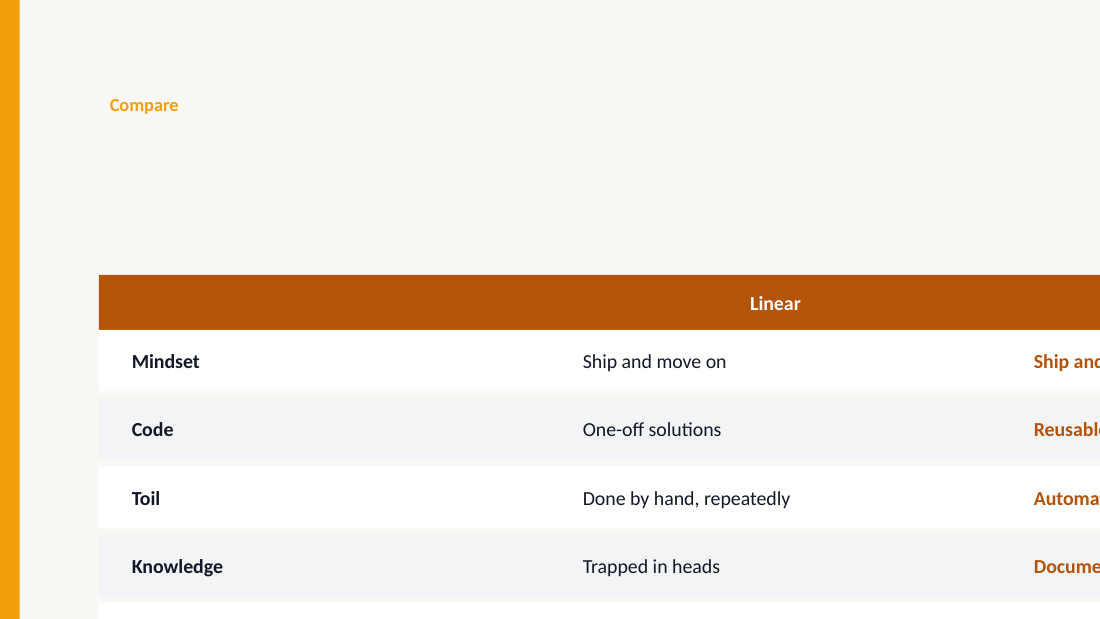
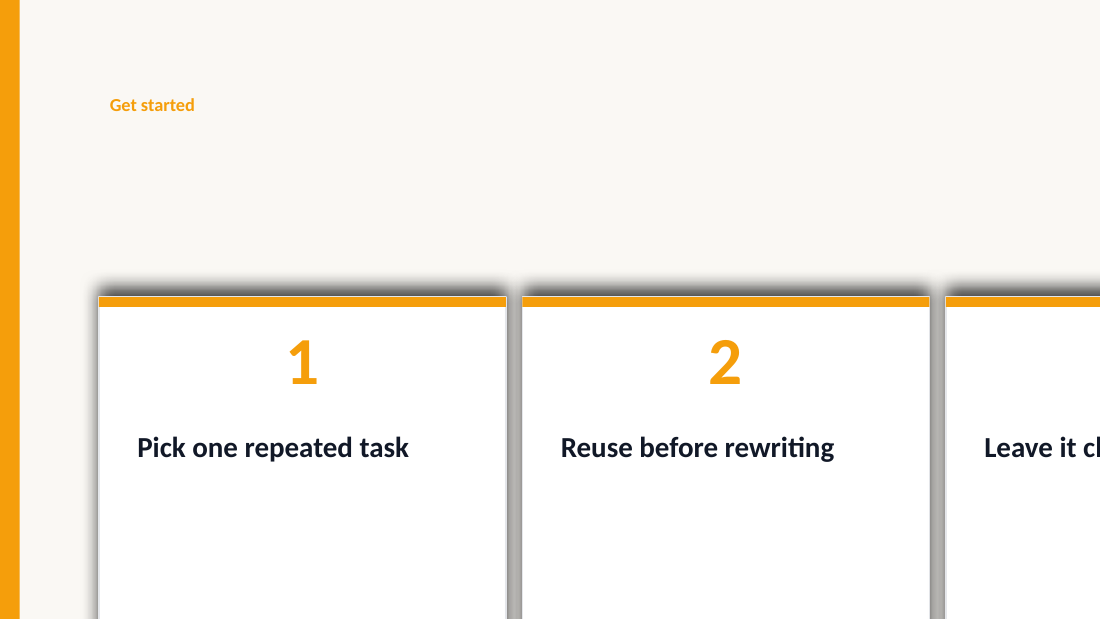
The script lays out for 13.333x7.5in but the file is 10x5.625in, so content runs off every slide — slide 12's takeaway is entirely invisible, slide 2's agenda is missing, and cards/tables on 3, 5, 7, 8, 10, 13 are cut off at the right and bottom edges.
Read all Show less Rubric Every slide is legible as rendered. FAIL if any slide has text running off the edge, text clipped by its container, text over an image or shape at unreadable contrast, or headline and body colliding. (A separate script check already catches overlapping text boxes; this question covers what the geometry check cannot see — overflow, clipping and contrast in the actual render.)
fail
Does the deck carry the guide's load-bearing compound-engineering substance?this case
Judge's reasoning
The 13-slide deck (build-pptx.js / Compound-Engineering.pptx) contains no AI-agent mechanics at all — no plan → work → review → compound loop, no CLAUDE.md/AGENTS.md, agents, skills or commands, no 80/20 shift and no staged adoption path; it substitutes generic craft advice ('Build for reuse', 'Automate the repetitive', 'Document as you build', '1.01^365 ≈ 37.7', 'Every PR should leave the touched files slightly better'), and the script even admits in its header comment that it invented the content ('assumed from every-visual-style.md, which is not present').
Read all Show less Rubric Does the deck carry the guide's load-bearing compound-engineering substance? PASS when it explains the plan → work → review → compound loop, makes the compound step the differentiator from ordinary AI-assisted work, and uses concrete artifacts such as CLAUDE.md, reusable agents, skills, or commands. It should also convey the guide's 80/20 shift and staged adoption path. FAIL when it substitutes generic AI productivity or prompting advice for those mechanics.
fail
Does the session make a deliberate choice about what matters most in the guide?this case
Judge's reasoning
No selection from the guide was made — the agenda on slide 2 ('Why most engineering work decays', 'Core principles: reuse, automate, document', 'How to start, and how to measure it') is a self-invented generic outline, so the deck never decides what in the guide's material matters most for the audience, and slides 3, 5, 7 and 11 largely restate the same linear-vs-compound point rather than building a prioritized argument.
Read all Show less Rubric Does the session make a deliberate choice about what matters most in the guide? PASS when the 30-minute deck selects and connects the guide's most consequential ideas for the audience. FAIL when it is effectively a table of contents—one slide per source heading in source order, without a point of view about what the audience should retain or change.
7 passed pass
No AI-tell wordingai-wording every task
deliverable text contains none of the shared AI-tell phrases in bench/ai-tells.txt. Files byte-identical to something the task shipped (its inputs, the selected case, or a member of a shipped zip) are the brief's text, not the model's, and are not inspected. Task checks may add narrower contractual bans, but must not repeat this shared floor.
inspected Compound-Engineering.pptx, build-pptx.js
Read all Show less pass
Deck opensopens this task
a .pptx exists and parses (python-pptx when installed, stdlib zip+XML otherwise)
pass
Slide countslide-count this task
8-20 slides -- sane for a 30-minute session
pass
No overlapping textno-overlap this task
no two text-bearing shapes on a slide overlap materially (Mike's first question: "Is the writing overlapped?")
pass
Slides renderrender this task
every slide rendered to a PNG in <output-dir>/_screenshots/ via LibreOffice (soffice --convert-to pdf) + pdftoppm. FAIL when required render tools are unavailable.
pass
One idea per slidethis task
Judge's reasoning
Each slide carries a single message — slide 3 contrasts linear vs compound, slide 7 is one comparison table, slide 10 one 'is not' clarification — with generous space and no slide stacking unrelated ideas.
Read all Show less Rubric One idea per slide. Mike: it fails "if it tries to fit too many ideas on one slide."
The brand guide says the same thing — "clear focal point: one main message per slide," "spacious, not cluttered."
FAIL if any single slide carries more than one idea, or is packed so densely that a room could not read it while the presenter talks.
pass
Useful visualsthis task
Judge's reasoning
Most content slides use shapes rather than bullets: paired cards (3, 10), three principle cards (5), a numbered progression (8), and a comparison table (7); only slides 9 and 11 are plain bulleted lists.
Read all Show less Rubric Real visual elements, not walls of bullets. Mike's question: "does it create good visual elements."
Real means: a diagram of the loop, a staged progression, a 50/50 split with illustration, a quote in an organic blob, a comparison built from shapes — something that carries meaning visually.
FAIL if the majority of content slides are a title plus a bulleted list.
judged by Claude