Dashboard
Claude Fable 5Claude Codehigh effortrun 21 Aug 2026
Instructions
Instructions — the case's current instructions
I want you to build a static html NPS dashboard and pick out interesting insights after doing analysis of the comments
I want you to build a static html NPS dashboard and pick out interesting insights after doing analysis of the comments

Every — NPS survey analysis
Deliverables
index.html— static, self-contained NPS dashboard (open directly in a browser; no server or network needed). KPIs, score distribution, segment mix, theme analysis, identity-framing analysis, 11 insight cards with supporting verbatims, and a filterable/searchable explorer of all 195 comments.ANSWER.md— this summary of insights.analyze.py→nps_analysis.json— reproducible analysis (NPS, theme tagging, framing stats).build_dashboard.pyrenders the HTML from the JSON.
Data: nps_and_descriptions_only.csv, 195 responses, two columns: NPS score (0–10) and the open-text answer to "How would you describe Every?"
Assumptions made: standard NPS cut-offs (9–10 promoter, 7–8 passive, 0–6 detractor); no date or customer metadata was supplied, so there is no trend or cohort split; themes were assigned by keyword/regex rules and then hand-checked against every comment, so counts are indicative rather than exact. Note the open-text question asks people to describe Every, not to justify their score — so sentiment is inferred from how people chose to describe it.
Headline numbers
| Metric | Value |
|---|---|
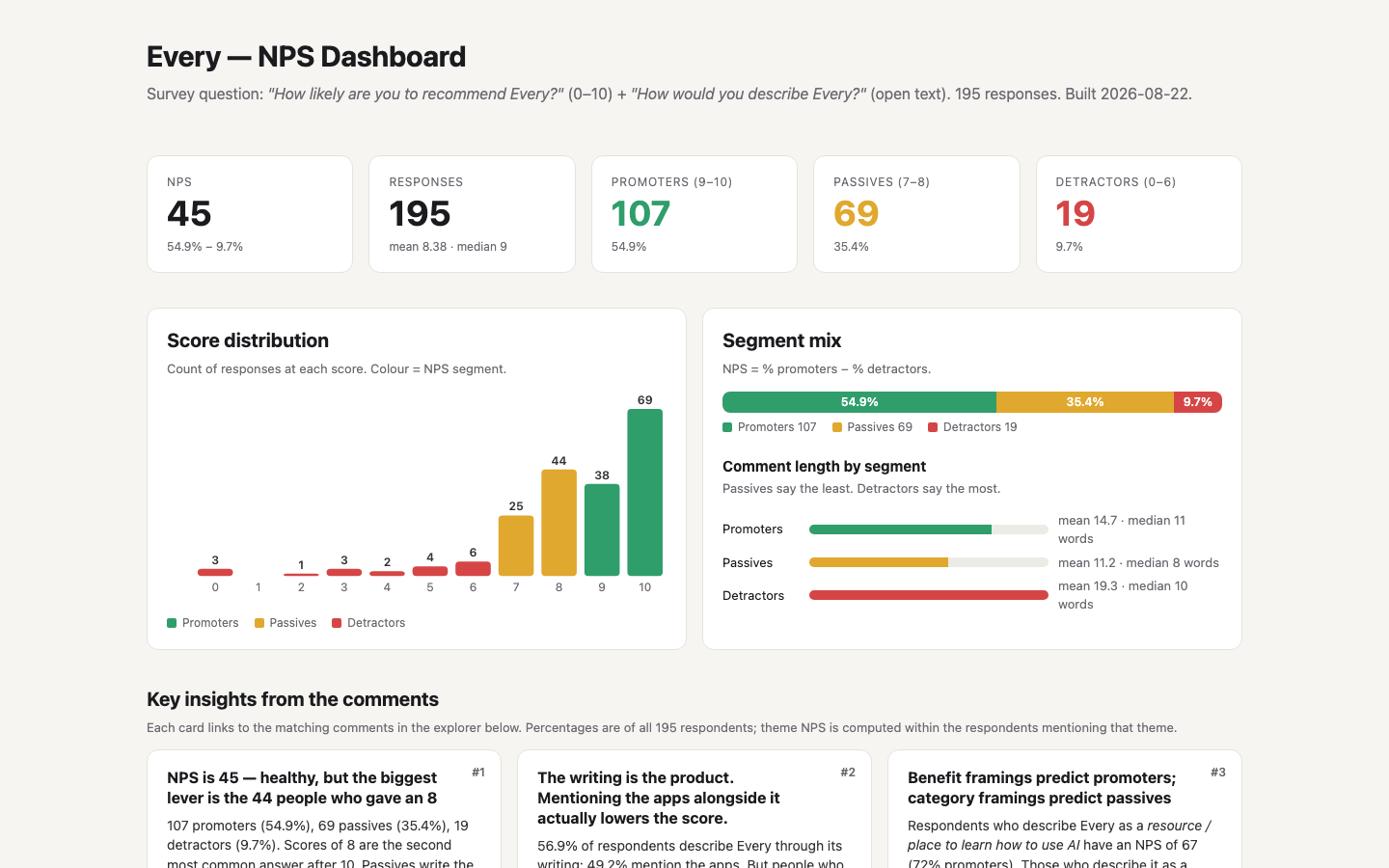
| NPS | 45 |
| Responses | 195 |
| Promoters (9–10) | 107 (54.9%) |
| Passives (7–8) | 69 (35.4%) |
| Detractors (0–6) | 19 (9.7%) |
| Mean / median score | 8.38 / 9 |
| Most common scores | 10 (69), 8 (44), 9 (38), 7 (25) |
NPS of 45 is solidly good for a paid media/subscription product. The structure of the distribution matters more than the headline: the detractor base is small (10%) and the passive base is large (35%), with 8 the second most common score. The upside is in converting 8s, not in fixing 0s.
Insights from the comments
1. Passives know what Every is but not why it matters
Passives write the shortest, flattest descriptions — median 8 words vs 11 for promoters and 10 for detractors — and they are almost all category labels: "A modern media company", "AI trends", "Good content", "An AI product lab", "Tech/AI magazine slash software incubating studio". Promoters, by contrast, describe an outcome ("The place to learn how to use AI") or a feeling ("Delights me"). The passive who comes closest to explaining their 8 says it directly: "an eclectic forward-looking newsletter that I pay a decent amount for but somehow it's worth it." Value is felt, but not articulated.
2. The writing is the product. Mentioning the apps alongside it lowers the score.
57% of respondents describe Every through its writing; 49% mention the apps. But framing matters:
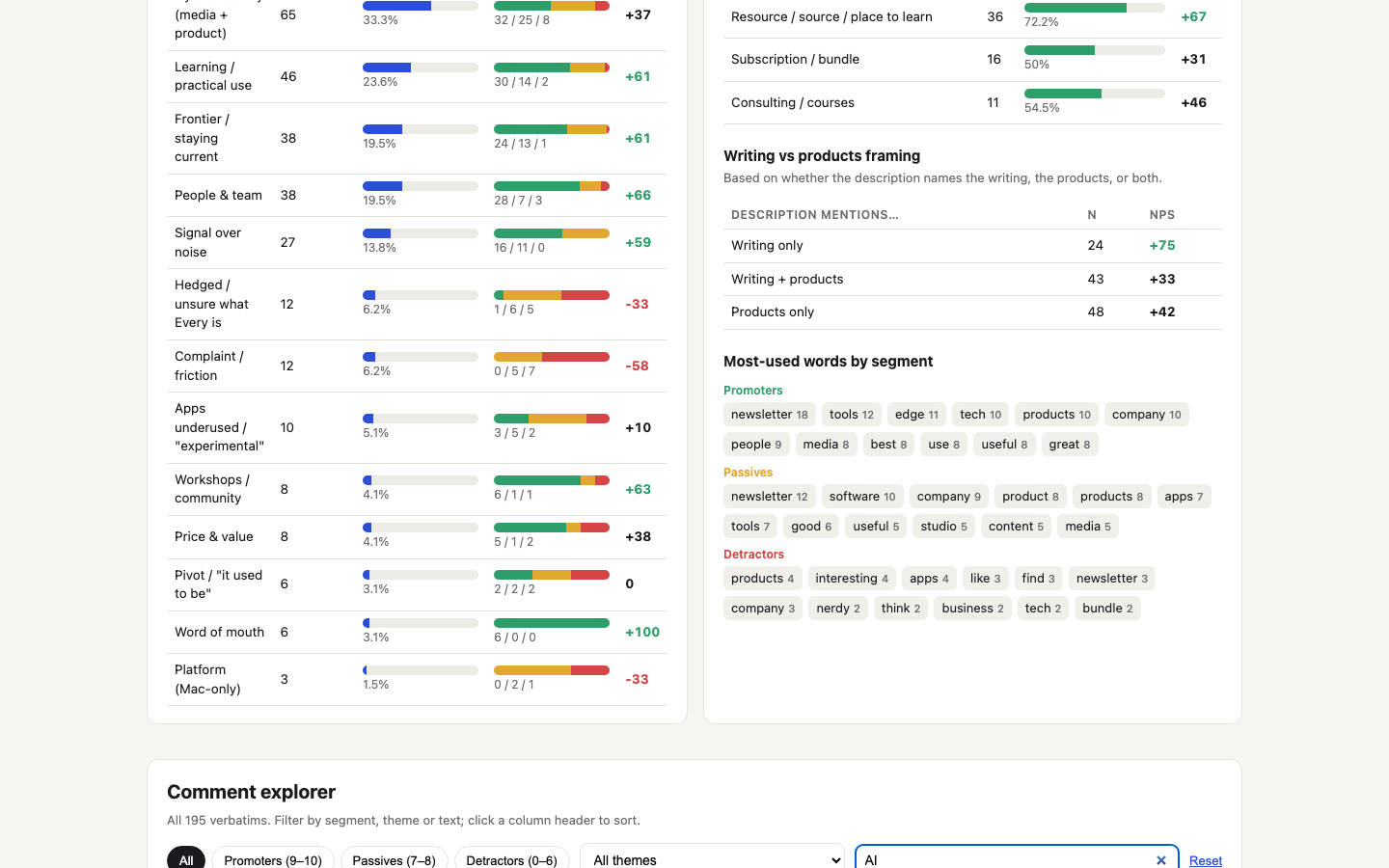
| Description mentions… | n | NPS |
|---|---|---|
| Writing only | 24 | +75 |
| Products only | 48 | +42 |
| Writing + products | 43 | +33 |
Promoters themselves say the apps are secondary: "I am there for the writing. It simply comes out of the noise." (10), "Subscription would be worth it for the writing alone" (10), "a whole bunch of useful apps… (which I still need to fully use!)" (10). Passives echo it with less warmth: "Premium newsletter bundle with products I should be using" (8), "Newsletter and early AI products" (8), "cute software products" (8), "scrappy software products" (7), "interesting experimental products" (7). The apps are currently a co-star that dilutes the story for a meaningful slice of subscribers, and ~10 respondents explicitly signal that they are not using them.
3. Benefit framings predict promoters; category framings predict passives
| How the respondent categorises Every | n | Promoter share | NPS |
|---|---|---|---|
| Resource / source / place to learn | 36 | 72% | +67 |
| Company / team / people | 41 | 61% | +51 |
| Studio / lab / incubator | 21 | 52% | +52 |
| Newsletter / publication | 67 | 55% | +48 |
| Products / apps / tools | 91 | 47% | +37 |
| Subscription / bundle | 16 | 50% | +31 |
The words "actually", "practical", "how to use AI" appear in 15 promoter comments, 5 passive comments and 0 detractor comments ("The best resource for having any hope of actually using AI in your daily work", "A place to learn about how ai is actually used", "smartest people i've found talking about how to actually leverage ai"). The positioning that converts is "the place to learn how to actually use AI", not "newsletter + app bundle" — which is how the 4-scorer put it: "A sub to a bundle of apps."
4. "Signal over noise" is the emotional core — and it has zero detractors
27 respondents praise Every for filtering the AI firehose, and not one of them is a detractor (NPS +59). The language is consistent: "without getting overwhelmed" (×2), "no fluff", "no slop", "no nonsense", "without the usual hype of nonsense", "comes out of the noise", "Rather than trying to catch up on every piece of AI news, I find it far more efficient—and much more insightful—to learn from the things you share." Frontier language ("cutting edge" ×6, "bleeding edge" ×3, "frontier", "front lines") shows the same split — 13 promoters, 4 passives, 0 detractors. Curation is the value; the frontier is merely the subject.
5. Identity confusion is a detractor signal
12 respondents hedged or literally couldn't answer: "No idea honestly" (7), "I don't know" (6), "They build apps and write about it?" (7), "An AI content and product studio ?" (7), "that's a hard one" (10), "Interesting hybrid company" (8), "Kinda weird intersection of nerdy AI shit and crafty business thinking" (5). NPS in this group: −33. A further third of all respondents (33%) reach for a hybrid construction — "media co meets blog meets startup studio", "magazine slash software incubating studio" — and that group scores below average (NPS +37). The "what is Every?" question is still doing work against you.
6. The pivot to AI is costing pre-AI-era subscribers
Six respondents describe Every as something it used to be, and three of the lowest scores in the survey are in that group:
- "It was... a collection of the best writers in tech & business as one bundle. Now.. I think it's 'a collection of the best on AI?'" (3)
- "I would about 2 years ago, but not anymore. I find Every less interesting after it switched over to AI and building products" (3)
- "It WAS a great resource for how people were using the AI for life and biz" (7)
Two promoters describe the same pivot approvingly ("started out as a newsletter collective but has pivoted to being an AI product development house that is at the frontier"), so this is not a verdict on the strategy — it's a churn-risk cohort that the writer-collective era acquired and the AI era isn't retaining. With no tenure data in the file, this can't be sized, but it's worth a cohort cut of churn by signup date.
7. The people are a differentiator — promoters describe humans, passives describe categories
38 respondents describe Every through its people (NPS +66; 28 promoters vs 7 passives). The adjectives are unusual for a media brand: "humble (willing to be honest about failures or blindspots)", "humility", "non-ego oriented", "abundance mindset", "educators at heart", "a mentor, a buddy in a multiplayer game who opened a hidden part of the map and tells you to follow them." Dan Shipper is the only individual named. Superlatives ("best", "must-read", "go-to", "top 3", "in the world") appear in 18 promoter comments vs 3 passive comments.
8. Mac-only is small but sharp: 3 mentions, 0 promoters, 1 cancellation
Only three respondents raise platform, but every one is a non-promoter and one 0-scorer says it is why they are leaving: "While the marketing talks about the tools I can use, I did not find out until after I subscribed that the majority are for Mac users." A 7 wishes the suite "ran on additional platforms besides Mac — Linux, especially"; an 8 notes Lex was valued precisely because it was the non-Mac product, and its spin-out was felt ("I upgraded after it branched off"). Stating platform requirements on the pricing page is a cheap fix for an expensive surprise.
9. Price sentiment is polarised — and two of the three zeros are about money and trust
Promoters: "I tell them it's a steal!", "Good value", "worth it for the writing alone." Detractors: "Good content, but they will abuse the trust and relationship and fleece you for more money" (0); "I think you were out of touch offering a High three figure Claude class" (0). Both zeros are about additional asks of existing subscribers — upsells appear to be where trust is being spent. The median view is the passive's: "a newsletter that I pay a decent amount for but somehow it's worth it."
10. Word-of-mouth is already happening, unprompted
Asked only to describe Every, six respondents volunteered that they already recommend it — "I have told approximately a dozen friends", "Have recommended it to two other people", "I've spent a lot of time talking about Every with founders", "It's where I send people who want to understand…" All six are promoters (NPS +100 in that group). A referral mechanism would harvest behaviour that already exists.
Named product love is concentrated: Monologue (3 mentions, "which I absolutely adore"), Cora (2, "just a short trial, but it was effective"), Sparkle (1), Lex (1). Workshops / Claude sessions / community get 8 mentions at NPS +63 ("The value in the workshops/learning session is almost worth it alone", "really beneficial workshops", "learn alongside others while you teach") — and even the 0-scorer rated the Claude sessions 8/10. If the apps need a front door, Monologue is it; if the bundle needs a second pillar, it's the live learning.
11. Detractors are engaged, specific and fixable
Detractors write the longest comments (mean 19 words vs 15 promoters, 11 passives) — the unhappy minority cares enough to explain. Their complaints are concrete:
- confusing product line-up and "underwhelmed with customer service" (4)
- apps unusable "for security reason" (2) — likely a corporate/IT constraint
- Mac-only (0, 7, 8)
- too technical / too dense: "Nerdy" (6), "nerdy AI shit" (5), "Cutting edge and insightful but not easy reading" (7), "non-stop claude if you're into that sort of thing" (7)
- the survey itself: "did anyone at Every try to use this survey tool? The text box is so tiny… It seems odd that a company preaches design and aesthetics has such a poor experience when asking about user experience." (0)
There is also an audience tension worth watching: one 9 calls Every "designed and communicated for non-engineers" while another calls it "a must have if you're a developer in 2025". Some passives and detractors are finding the current mix too technical.
What I'd do with this
- Lead with the writing and the outcome ("learn how to actually use AI"); make the apps an earned discovery, not the headline of the bundle. The data says the writing-only framing produces the happiest subscribers and that "bundle" framing produces the least happy.
- Fix the app onboarding: ~10 respondents (including 10-scorers) admit they don't use the apps. Start with Monologue, the only app people spontaneously say they love.
- Put platform requirements (macOS) on the pricing page. It's one line and it cost at least one subscriber.
- Audit upsells to existing subscribers (high-ticket courses, "Claude class"). Both money-related zeros are about being asked for more after subscribing.
- Run a tenure cohort cut of churn to size the pre-AI-era attrition the comments hint at.
- Add a referral path — promoters are already recommending by the dozen.
- Fix the survey text box. A detractor told you so, at length.
Method notes
- NPS = % promoters − % detractors = 54.9 − 9.7 = 45.1.
- Themes: regex rules in
analyze.py(THEMESdict), reviewed against every comment and adjusted (e.g. case-sensitive "WAS" for the pivot theme; "platform" excluded from the Mac-only theme). A comment can carry several themes. - Per-theme NPS on small groups (n < 15: Mac-only, pivot, word of mouth, price, workshops, apps-underused) is directional only.
- "Identity framing" and "writing vs products framing" are keyword-based: a description counts as mentioning writing if it uses newsletter/publication/magazine/blog/media/journalism etc., and products if it uses apps/tools/software/products.