Mike's Checks/deepseek-v4-flash/09 pptx
09 pptx
deepseek-v4-flashCodex CLIhigh effortrun 4 Sep 20261,572,800 tokens
▸Instructions — the case's current instructions; none were saved with this result
create a powerpoint in the every brand style on compound engineering, 30 min session https://every.to/guides/compound-engineering
A pptx skill is in skills/pptx/ — read skills/pptx/SKILL.md first. pptxgenjs is installed in the workspace, so require("pptxgenjs") works from here with no network. The brand guide is every-visual-style.md.
Answer
Checks
7/15No overlapping textno-overlap
no two text-bearing shapes on a slide overlap materially (Mike's first question: "Is the writing overlapped?")
Brand colorspalette
share of rendered pixels on Every's documented palette, and whether the deck stays inside one theme (needs Pillow)
Deck opensopens
a .pptx exists and parses (python-pptx when installed, stdlib zip+XML otherwise)
Slide countslide-count
8-20 slides -- sane for a 30-minute session
Slides renderrender
every slide rendered to a PNG in <output-dir>/_screenshots/ via LibreOffice (soffice --convert-to pdf) + pdftoppm. FAIL when required render tools are unavailable.
Q1Required design elements
Judge's reasoning
The deck contains zero images — no E/O/R brushstroke SVGs and no stippled classical illustration on any slide; the pale cyan ellipses (s1, s5, s12) are plain vector circles standing in for the swooshes.
▸Rubric
The signature elements are there. Every decks carry organic brushstroke swooshes (the E / O / R SVG shapes, cropped at the slide edge, scaled large) and stippled classical illustrations — Greek and Roman architecture, figures, busts, sometimes with modern elements. The guide says to use the swooshes "liberally once every two or three slides." FAIL if the deck has neither swooshes nor classical illustration, or if such elements appear on fewer than roughly one slide in three. Mike's question on this eval: "does it use the, uh, SVGs?"
Q2Consistent footer
Judge's reasoning
The footer renders on all 13 slides, but Theme 1 requires 'every.to' at right and the deck prints the full path 'every.to/guides/compound-engineering' — a minor deviation that is consistent, so the substantive failure is elsewhere; on strict reading of consistency this passes.
▸Rubric
The footer is consistent. Theme 1: EVERY logo left, `every.to` right. Theme 2: EVERY *Consulting* left, session indicator right. FAIL if content slides carry no footer, or if the footer appears on some and not others.
Q3Interesting material
Judge's reasoning
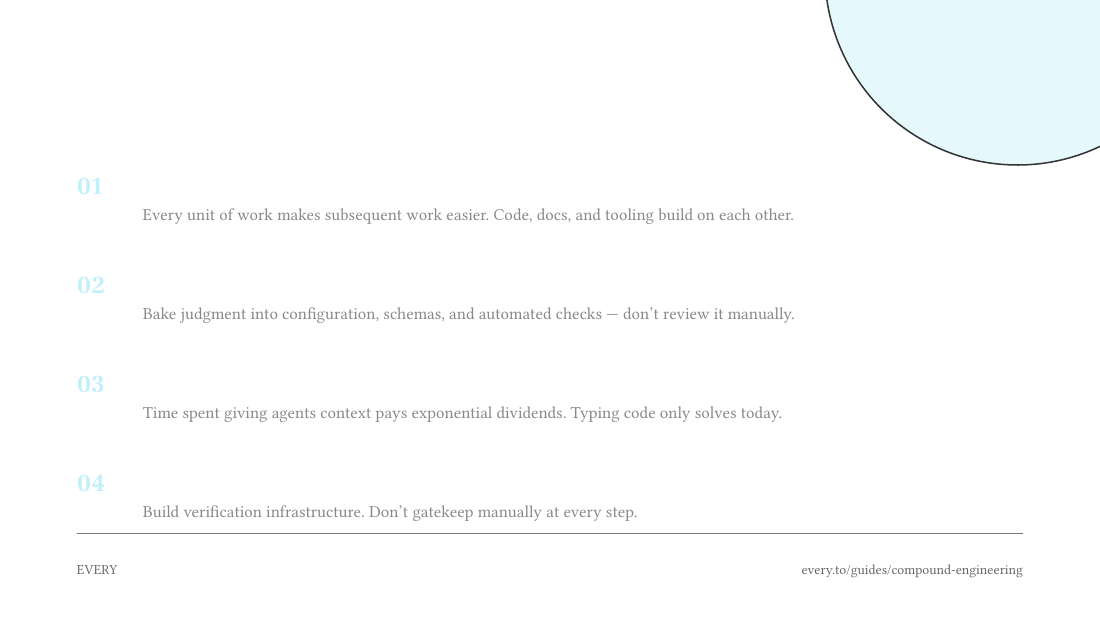
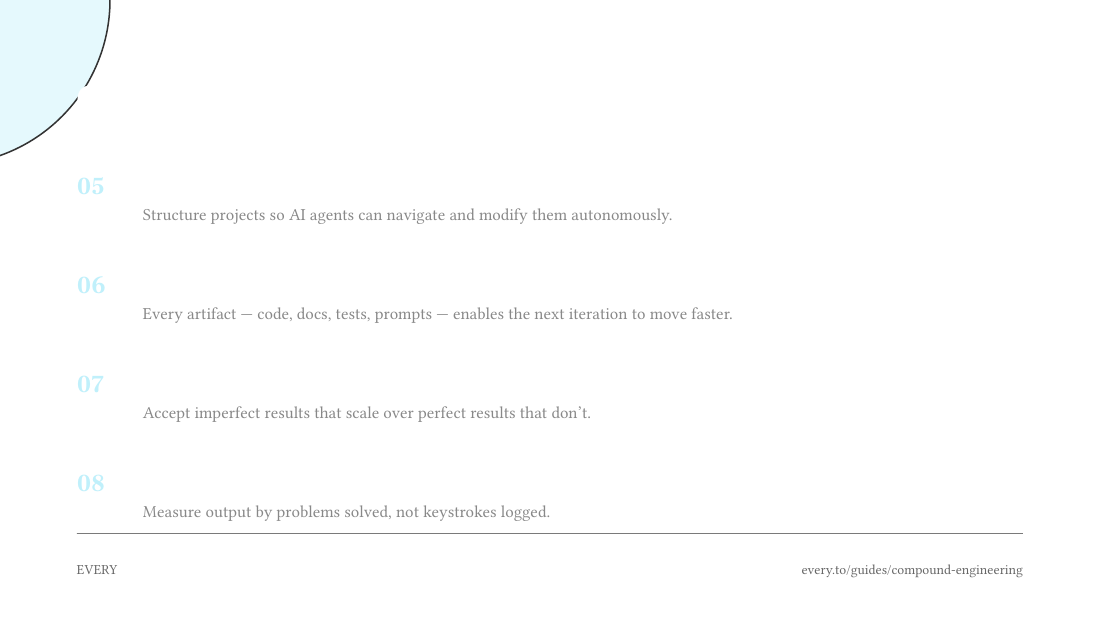
The deck is a table of contents of the guide — problem, solution, loop, then '1. Plan', '2. Work', '3. Review', '4. Compound' in order, then all eight principles restated verbatim across s10 and s11 with a literal 'Core Principles (cont.)' header; nothing is cut or argued for this audience.
▸Rubric
It picked interesting things to say. Mike's question on this eval: "does it pick out interesting things to write about." A 30-minute session forces a choice about what matters. FAIL if the deck is a table of contents of the guide — one slide per heading, in the guide's order, with the headings restated and no point of view about what this audience should take away.
Q4One idea per slide
Judge's reasoning
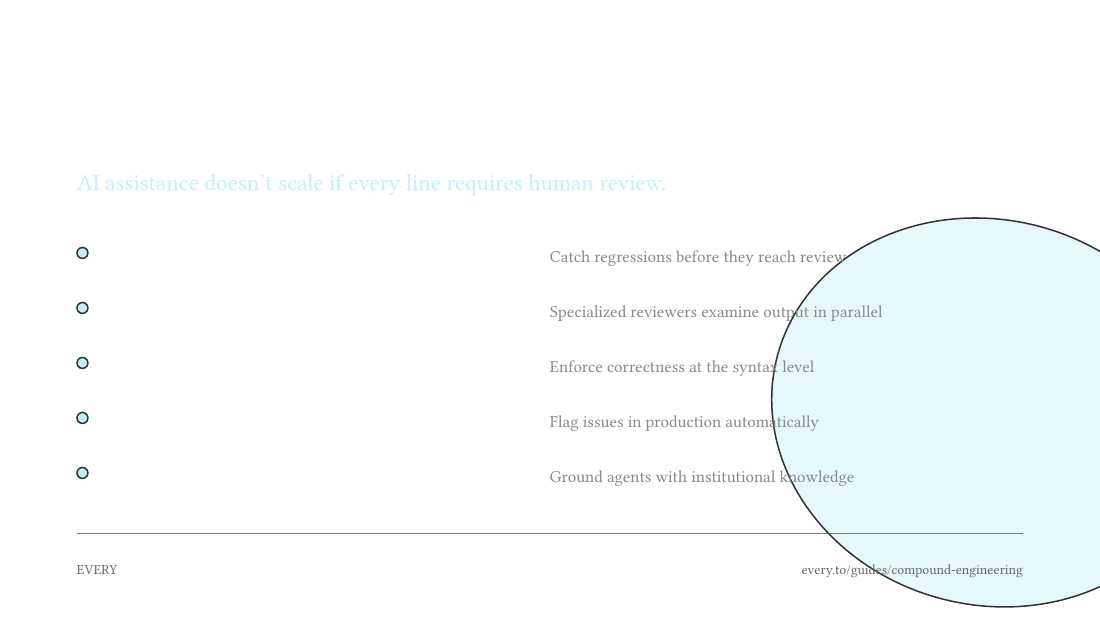
Slides 10 and 11 each carry four distinct, unrelated principles with title plus full explanatory sentence, and s12 packs five two-part safety-net rows under a headline — the '(cont.)' spillover is itself the tell that one message per slide was abandoned.
▸Rubric
One idea per slide. Mike: it fails "if it tries to fit too many ideas on one slide." The brand guide says the same thing — "clear focal point: one main message per slide," "spacious, not cluttered." FAIL if any single slide carries more than one idea, or is packed so densely that a room could not read it while the presenter talks.
Q5Useful visuals
Judge's reasoning
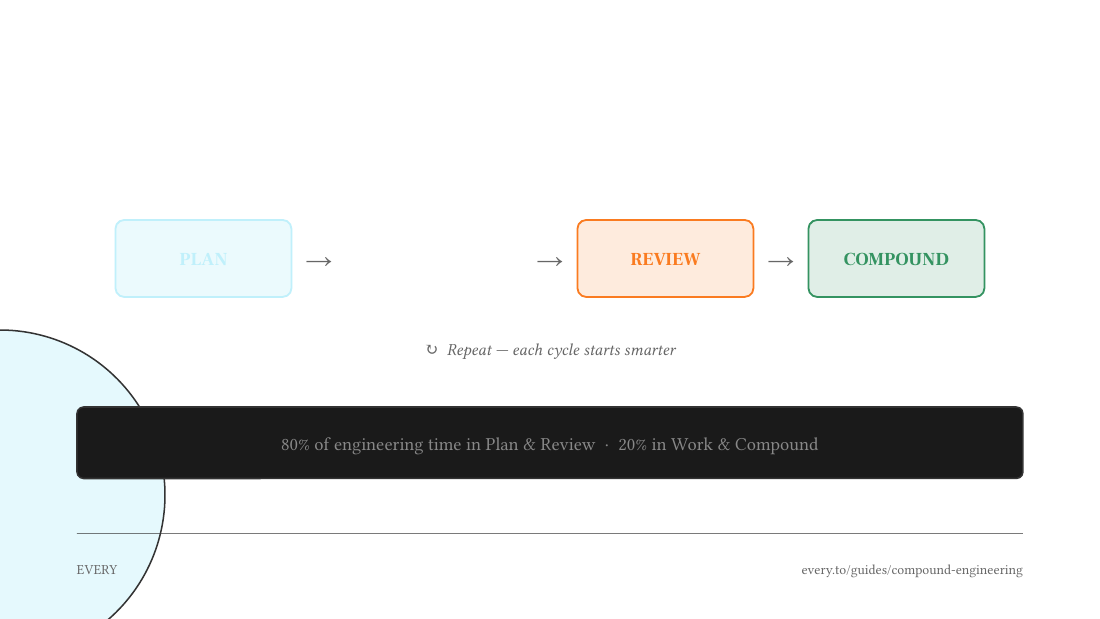
Of the 12 content slides only s4 (loop diagram) and s9 (50/50 split cards) carry meaning visually; s2, s3, s5, s6, s7, s10, s11, s12 and s13 are all title-plus-list, a clear majority.
▸Rubric
Real visual elements, not walls of bullets. Mike's question: "does it create good visual elements." Real means: a diagram of the loop, a staged progression, a 50/50 split with illustration, a quote in an organic blob, a comparison built from shapes — something that carries meaning visually. FAIL if the majority of content slides are a title plus a bulleted list.
Q6Readable slides
Judge's reasoning
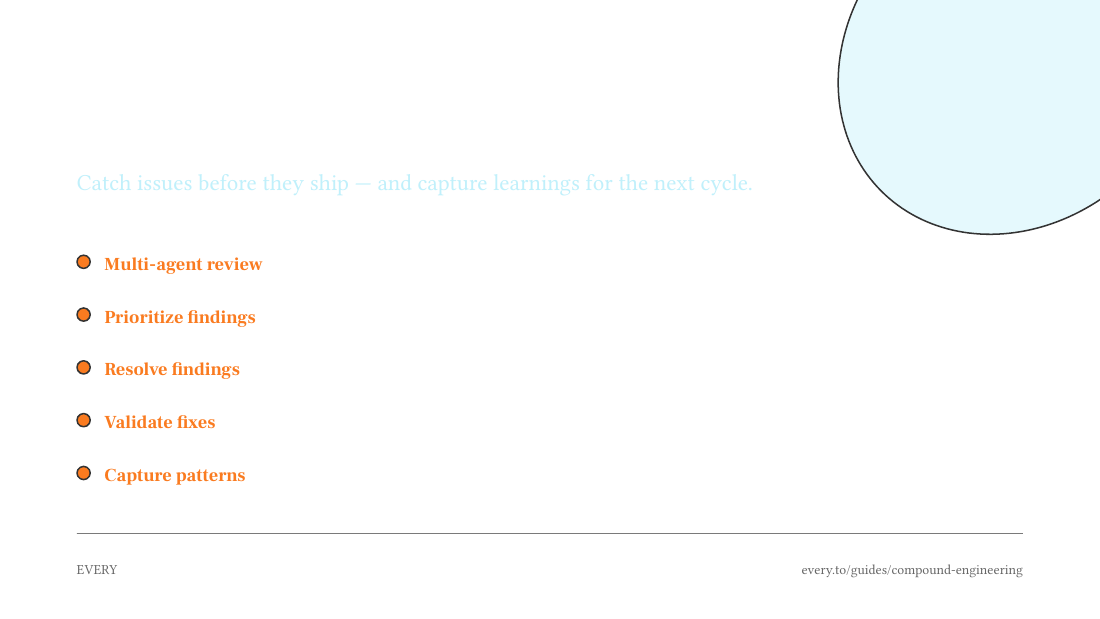
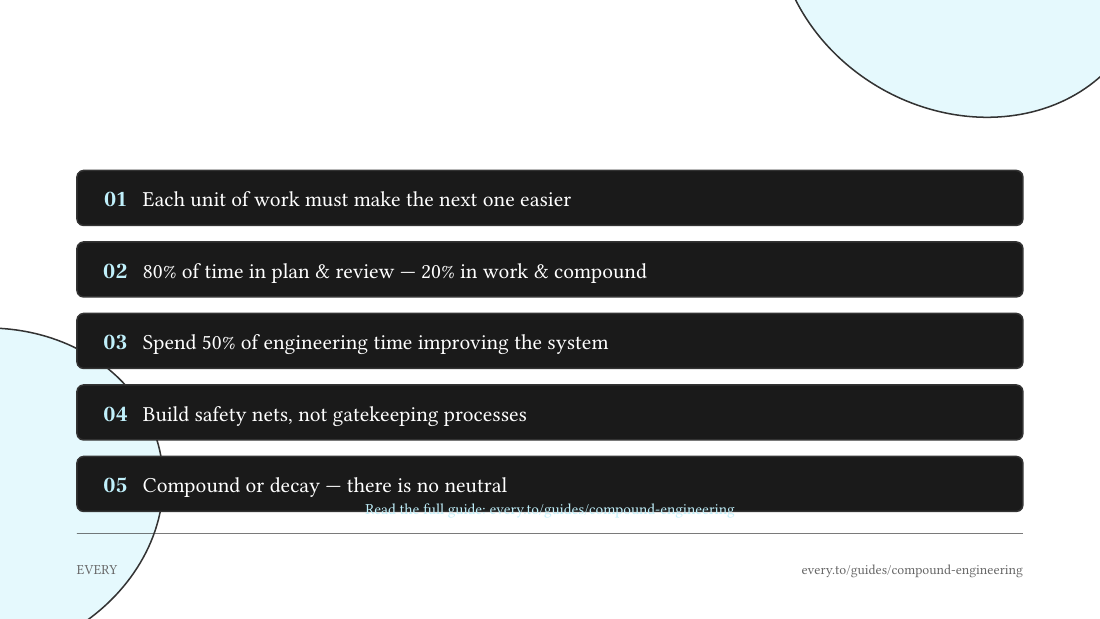
The #121212 background is never applied, so white text renders invisible on white: the s1 title 'Compound Engineering' is gone, s2 shows only a clipped 'Th', s4's WORK box is missing from the loop, s10/s11 lose all eight principle titles, and s13's '05' row collides with the 'Read the full guide' line.
▸Rubric
Every slide is legible as rendered. FAIL if any slide has text running off the edge, text clipped by its container, text over an image or shape at unreadable contrast, or headline and body colliding. (A separate script check already catches overlapping text boxes; this question covers what the geometry check cannot see — overflow, clipping and contrast in the actual render.)
Q7Every's color palette
Judge's reasoning
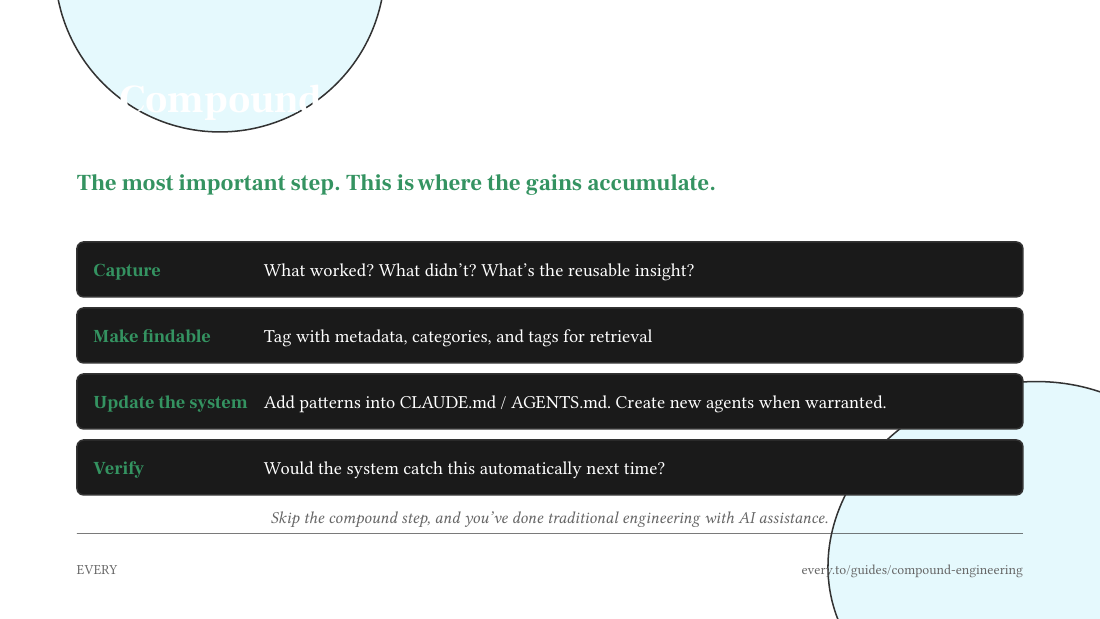
Accents are exact Theme 1 hexes — Every Blue #C0F0FB circles (s1, s3, s13), #FA7B20 bullets (s7), #349361 (s8, s9), #121212 cards (s8, s9, s13) — consistently one theme, no corporate blue or gradients; the intended #121212 background was defined but never applied, which is scored under Q10.
▸Rubric
The palette is Every's. Theme 1 (Editorial): background Every Black `#121212` (or Warm Cream `#F5F2ED` for light slides), Every Blue `#C0F0FB` as the signature accent, white text, with `#FA7B20` / `#E9731E` / `#C4400F` / `#349361` / `#1324CB` / `#7301CC` as accents. Theme 2 (Consulting): background Teal Dark `#0F5258` with Teal Medium `#4999A0` for depth, Warm White `#FFFEFB` text, `#BB7B19` / `#F8DE6E` / `#2E8D23` accents. FAIL if the deck's colors are visibly not these — corporate blue, generic slide-template gray, purple-black AI dark mode, neon gradients — or if it flips between the two themes across slides. Close-but-different shades are fine; a different palette is not.
Q8Serif typography
Judge's reasoning
Every text run in the build sets fontFace 'Georgia' — headlines, body, numbers and footers alike — and the renders confirm serif throughout (s3 quote, s9 '50%', s10 numerals).
▸Rubric
Typography is serif. The brand is serif-first: Signifier, or its documented PowerPoint substitutes Georgia and Times New Roman. Sans-serif (Switzer / DM Sans) is allowed only for small labels — session indicators, footers, captions. FAIL if headlines or body text are set in a sans-serif face (Arial, Helvetica, Calibri, Inter). "Sans-serif for main content" is on the brand guide's explicit avoid list.
Q9No banned decoration
Judge's reasoning
Only ellipses and rounded rectangles appear; no triangles, hexagons, diagonal slashes, corner brackets, drop shadows, double borders, stock photos, gradient backgrounds or rotated/outlined text on any of the 13 slides.
▸Rubric
No forbidden decoration. The brand guide bans, in both themes: triangles, hexagons and other geometric accents; diagonal slashes and hard section dividers; corner brackets or L-shaped frames; drop shadows on boxes; heavy or double borders; stock photography; gradient backgrounds; rotated or outlined text. FAIL if any of these appears on any slide.
Q10Enough substance
Judge's reasoning
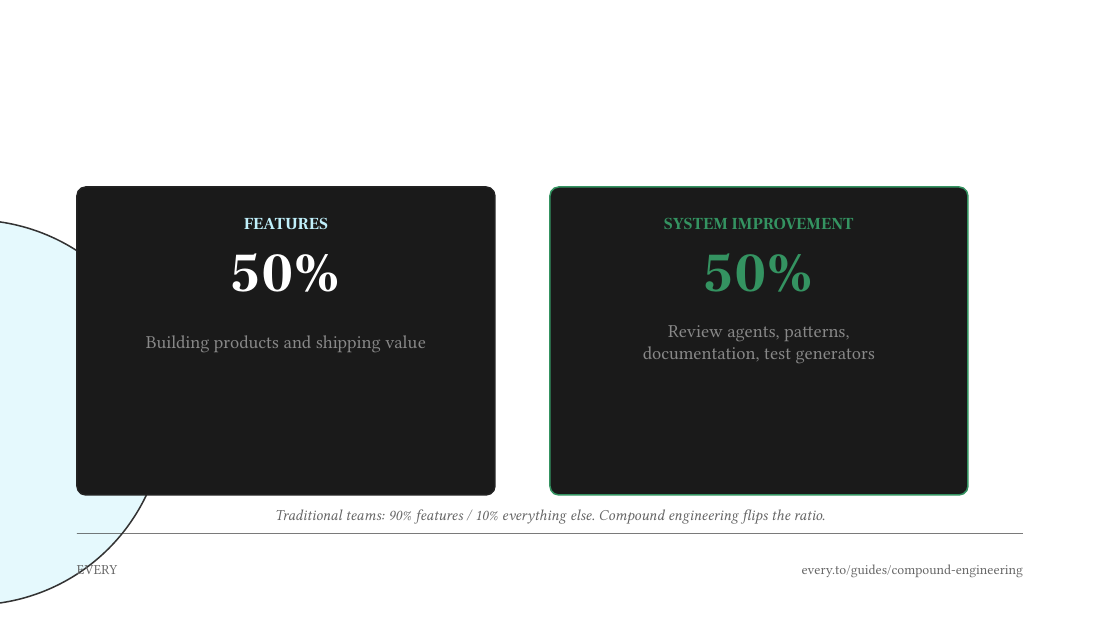
The deck carries load-bearing guide substance: the plan→work→review→compound loop with compound named as the differentiator (s8: 'Skip the compound step, and you've done traditional engineering with AI assistance'), the 80/20 split (s4), the 50/50 rule (s9), and CLAUDE.md / AGENTS.md as the compounding artifact (s8, s12).
▸Rubric
The content has real depth. Mike: "the main failing of the decks generated by AI is still the content is quite shallow." The deck must carry the load-bearing substance of the compound-engineering guide — for example the four-step loop (plan → work → review → **compound**) with the compound step named as the thing that separates it from ordinary AI-assisted work, the 80/20 split where planning and review take most of an engineer's time, the specific compounding artifacts (CLAUDE.md, reusable agents, skills, slash commands), the beliefs the philosophy asks you to drop, and the staged 0→5 path. FAIL if the deck could have been written without ever reading the guide — generic "AI makes engineers faster / here are some prompting tips" content, or claims about compound engineering that the guide does not support.