Mike's Checks/gpt-5.6-sol/11 hoboken-map
11 hoboken-map
gpt-5.6-solCodex CLIhigh effortrun 22 Aug 2026
▸Instructions — the case's current instructions; none were saved with this result
11 — Neighborhood map + self-validating "hidden gem score"
This is a short multi-turn task. There are no data inputs — do your own
public web research to find real places. Treat the prompts below as a
conversation that arrives in order; the interesting one is the last.
Prompts (in order)
- My wife and kids and I just moved to north Hoboken — make me an interactive
map of family recommendations (playgrounds, food, activities, day trips). - Can you add a date-night category?
- What about a tapas place?
- Now work on a proprietary "hidden gem" score. Determine a way to measure
it and validate that it matches expectations. Use public data where possible.
What "good" looks like
- A single self-contained, interactive map artifact (
index.html) a non-technical
family member could open and use, with the categories above. - Real, plausibly-correct Hoboken-area places — not invented ones.
- For prompt 4: a genuinely thought-through metric. Pre-register a methodology
and your priors/expectations before collecting and scoring data, then test the
computed scores against those locked priors and report how well they matched.
Keep the methodology, the data, the scores, and the validation as inspectable
files (e.g. a methodology writeup, a data file, a scoring script, a scores file).
Once produced, the artifact must open and work by double-clicking index.html —
no build step, no local server, no API keys, nothing to install. Loading a mapping
library and map tiles from a public CDN is expected and fine; "no API keys" means
no paid or credentialed services, not no network.
Answer
North Hoboken family map — delivery note
Open index.html by double-clicking it. There is no build step, local server, account, or API key. An internet connection is needed only for the Leaflet library, OpenStreetMap tiles, and outbound place links; all recommendations and scores are embedded in the HTML and still appear as a list if map tiles cannot load.
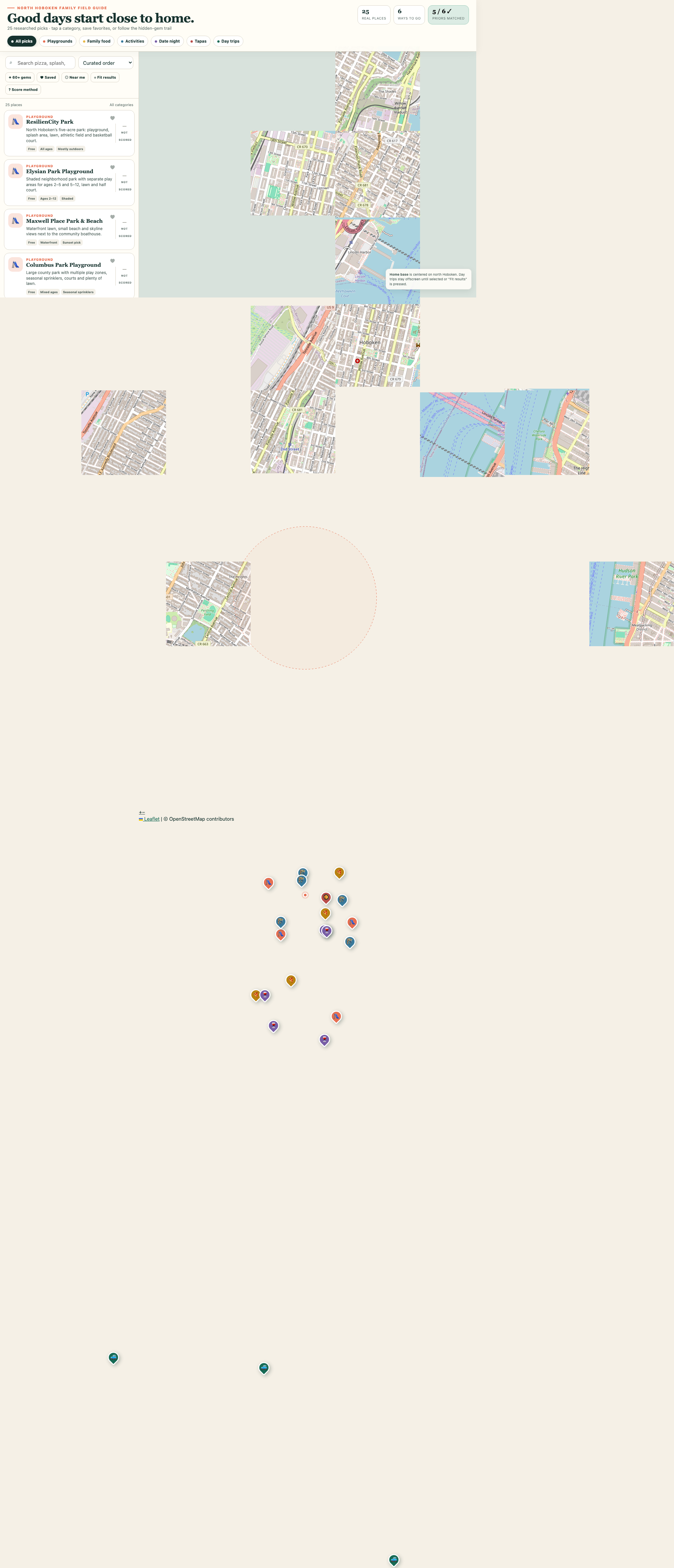
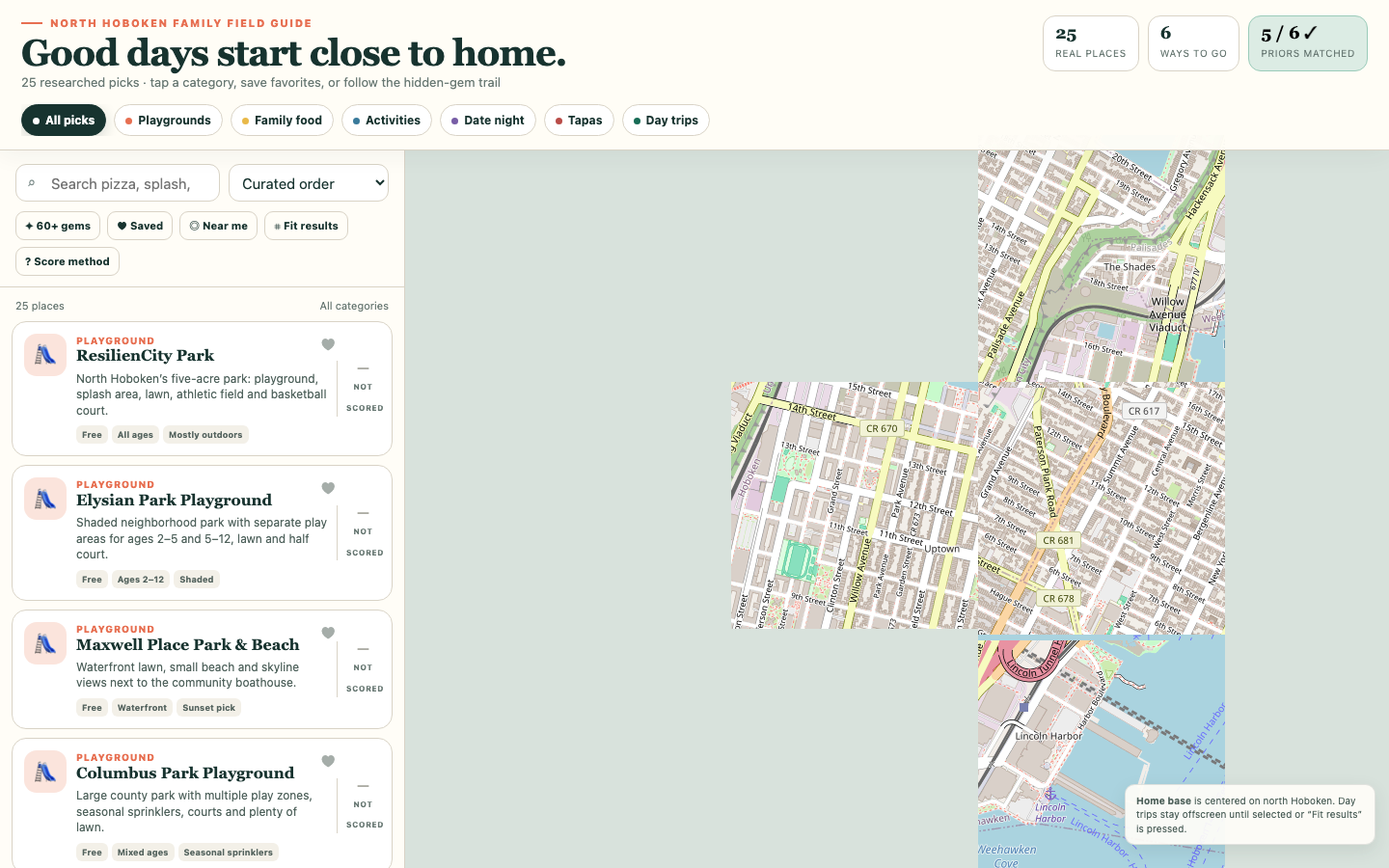
The guide includes 25 researched picks across playgrounds, family food, activities, day trips, date night, and a dedicated tapas category. It supports category/search filtering, favorites saved in the browser, geolocation-based distance sorting, map/list selection, directions, official links, score sorting, and a “60+ gems” filter.
Hidden-gem result
The definitive methodology and six expectations were locked and hashed before the rating/review-count snapshot was collected. The prospective test passed:
- 5 of 6 locked expectations matched (83.3%);
- both calibration anchors passed;
- all 14 eligible observations were complete;
- all four preregistered robustness variants passed.
The top scores were Hoboken Historical Museum (76.2), The Gravity Vault (75.0), and Fiore’s (61.6). Fiore’s was the one prediction miss: its exceptional rating outweighed its very high visibility, and that miss was retained rather than tuning the formula.
Inspectable deliverables
index.html— double-clickable interactive map with embedded place and score dataplaces.json— complete recommendation data, links, coordinates, and scoring eligibilityMETHODOLOGY.md— definitive preregistration (SHA-2561a7cc274eaeea24393e3f588830fdb653902126e116d384f168c26247612fdc7)PREREGISTRATION_LOG.md— timing, hash, and preserved invalidated pilot recordscore_inputs.json— public review observations and direct source URLsscore_hidden_gems.py— deterministic, standard-library scoring and validation scriptscores.csv/scores.json— computed ranks and all score componentsVALIDATION.md— prospective prior tests, acceptance criteria, and robustness resultsSOURCES.md— public place research and score-source ledger
To reproduce the score outputs, optionally run python3 score_hidden_gems.py; this is not needed to use the map.
Checks
7/8Map loadsrenders
a visible map container of at least 300x200 with >= 5 markers, in a headless browser. Cannot pass without Playwright installed.
Required categoriescategories
all six categories the prompt asks for are named somewhere in the output: playgrounds, food, activities, day-trips, date-night, tapas.
Required filesartifacts
the run left all four of a methodology write-up, a data file, a scoring script and a scores file.
Reproducible scoringreproducible
the scores file is deleted in a scratch copy and the scoring script re-run: it has to finish inside 180s and write the scores back. Missing grader prerequisites fail.
gems-vs-traps Retired
Retired check; no longer defined in the repo.
Q1Easy for family to use
Judge's reasoning
index.html opens by double-click with no build/server/keys, and the screenshots show a labeled sidebar of named places, readable category chips, search, and sort controls rather than raw data.
▸Rubric
Usable by a non-technical family member. Look at `map.png` and `full.png`, and at how `index.html` is meant to be opened. The bar, in the reviewer's words: "It's a single self-contained interactive map artifact, uh, that someone could open and use basically by clicking on the HTML." FAIL if using this would require technical knowledge — a build step, a local server, a terminal command, editing a file, or an interface that shows raw data (JSON blobs, coordinate dumps, unlabeled controls) instead of named places and readable categories. PASS if double-clicking the file gives someone a map with labeled places and controls they could figure out unaided.
Q2Criteria fixed before scoring
Judge's reasoning
METHODOLOGY.md states six falsifiable priors and acceptance criteria in place-level terms, hash-locked and logged before input collection, and VALIDATION.md reports a genuine test that one prior (Fiore's) failed and was retained untuned.
▸Rubric
Priors were locked before scoring. Read the methodology writeup and the scores/validation files. The prompt asked it to "**Pre-register** a methodology and your priors/expectations *before* collecting and scoring data, then test the computed scores against those locked priors and report how well they matched." FAIL if the priors read as written after the results were known — signals: no distinct set of priors stated separately from the findings; priors phrased in terms of the computed scores rather than as expectations about places or patterns; a "validation" section that restates the scores instead of describing a test the priors could have failed. PASS if there is a stated set of expectations that came first and a reported comparison against them, whether they held up or not.
Q3Real places
Judge's reasoning
Spot-checked Hoboken Historical Museum (1301 Hudson St, the top hidden gem), Fiore's House of Quality (414 Adams St), The Gravity Vault (1423 Clinton St), Lola's Tapas Bar (153 14th St), and Liberty Science Center — all real, correctly addressed, and plausibly geocoded.
▸Rubric
Places are real. Pick five places from the map — spread across categories, including at least one the output calls a hidden gem — and check them against what you know about Hoboken and the surrounding area. The bar, in the reviewer's words: "real plausibly correct Hoboken area places, not invented ones." FAIL if any of the five is one you can positively identify as fabricated or misplaced — a business that does not exist, a name attached to the wrong town, or coordinates that put it far from where it actually is. If you cannot positively identify a problem with any of the five, PASS.